
Free Honda VIN Decoder vs History Report: What You Might Miss
Search Vehicle Report
Table of Contents
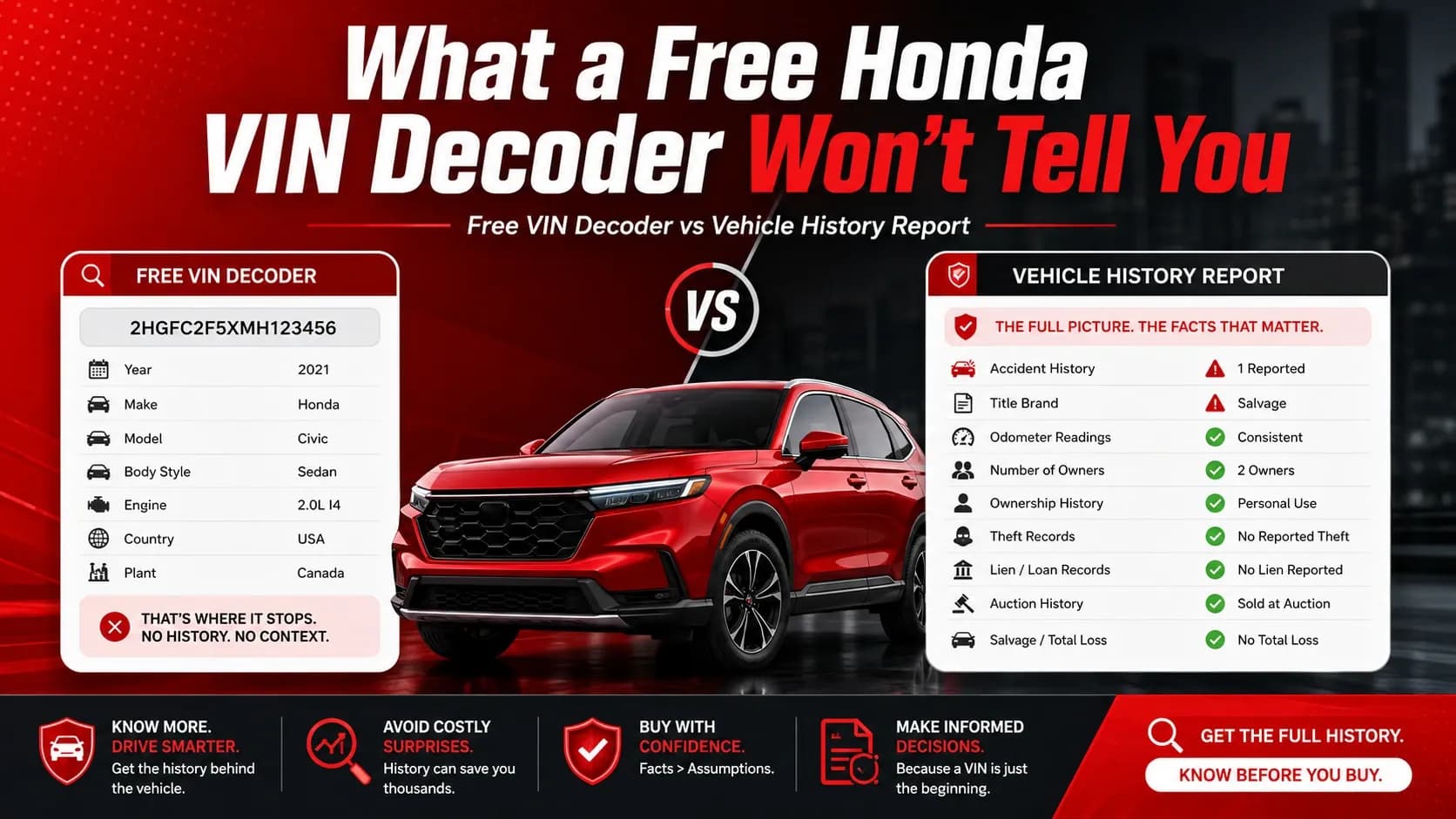
A free Honda VIN decoder is a good first step. It can help confirm the Honda’s year, model, trim, engine, fuel type, body style, and other basic specs. But it does not tell the whole used-car story.
That’s where a Honda vehicle history report comes in. It can show deeper records tied to the car’s past, such as accident history, title brands, odometer readings, ownership changes, theft records, liens, auction activity, and salvage history.
So yes, start with a free Honda VIN decoder. Just don’t stop there if you’re close to buying.
Key Takeaways
 A VIN decoder tells you what the Honda is; a history report helps show what may have happened to it.
- A Honda VIN report can reveal risk records that a basic decoder usually does not show.
- Used-car buyers, sellers, and flippers should use both tools at different stages of the deal.
Start Here: What a Free Honda VIN Decoder Can Show
A VIN decoder takes the 17-character VIN and pulls out the basic identity of the Honda. It is a bit like checking the tag on a jacket before buying it — size, material, brand, the essentials.
For early research, that is often enough.
Year, Make, and Model
A decoder can tell you whether the VIN points to a Honda Civic, Accord, CR-V, Pilot, Ridgeline, Odyssey, or another Honda model.
That sounds basic, but it matters. Listings can be wrong. Dealer feeds can be messy. Private sellers sometimes guess the trim or model year.
Trim and Body Style
A Honda VIN check may help confirm trim and body style details. This can help you spot a listing that says “Touring” when the VIN points to a lower trim.
That small difference can change value.
Engine and Fuel Type
It may also show engine size, cylinder count, fuel type, drivetrain, or transmission details, depending on what the tool can read.
That helps with buyer checks, parts research, insurance quotes, and cleaner resale listings.
Assembly Details
Some decoders can show production details such as plant, country, or serial sequence. Not the most exciting stuff, sure, but it helps confirm the vehicle identity.
So far, so good.
But here’s the thing: identity is not history.
What a Free VIN Decoder Usually Does Not Show
This is where buyers sometimes get tripped up. A VIN decoder can make a car feel “checked,” but it has only checked one layer.
It tells you what the Honda is. It does not tell you what the Honda has been through.
Accident Records
A free decoder usually does not show Honda accident history. It may confirm the vehicle specs, but it will not tell you whether the Honda was in a reported crash.
That matters because accident history can affect resale value, safety concerns, repair quality, and buyer confidence.
Odometer Problems
A decoder may show the vehicle’s original specs, but it usually will not show mileage records over time.
That means it cannot help much with odometer rollbacks, strange mileage gaps, or inconsistent mileage entries.
Title Brands
A basic VIN decoder will not usually show whether a Honda has a salvage, rebuilt, flood, lemon, or other branded title record.
A title brand can change the way a car is priced and financed. It can also affect insurance.
Ownership Changes
A decoder does not normally tell you how many owners the Honda has had or how often it changed hands.
A car can have one careful owner or five rushed owners. Same VIN. Very different story.
Lien, Theft, Auction, and Salvage Records
These records sit outside basic VIN decoding. You need deeper report data to check them.
And honestly, these are the records that can save you from a bad surprise.
What a Honda Vehicle History Report Can Reveal
A Honda vehicle history report is built for used-car background checks. It does not replace a mechanic’s inspection, and it does not promise perfection. But it can show records that help you ask better questions before money changes hands.
Honda Accident History
A report may show accident records, damage events, or reported collision details tied to the VIN.
This does not tell you every scratch or parking-lot ding. Some damage never gets reported. Still, if a report shows a major accident, you now know what to inspect more carefully.
Look at panel gaps. Look at paint texture. Check the bumper edges, hood bolts, trunk floor, and radiator support area. A history record gives you a trail to follow.
Honda Title Check
A Honda title check can reveal title brands such as salvage, rebuilt, flood, junk, lemon, or other serious records.
This is big. A branded title can make a Honda cheaper up front but harder to insure, finance, or resell later.
Some buyers are comfortable with rebuilt vehicles when the repair work is documented. Others want to avoid them completely. Either way, you should know before you buy.
Honda Odometer Check
A Honda odometer check can show mileage readings from different points in the vehicle’s life.
You want the mileage story to make sense. If the Honda had 92,000 miles three years ago and now shows 61,000 miles, that needs an explanation. Maybe it is a data error. Maybe not.
Mileage is one of those numbers people trust too quickly. Don’t.
Ownership History
A history report may show how many owners the Honda has had and, sometimes, the length of ownership.
One owner is not always better. Multiple owners are not always bad. But ownership patterns can tell you something.
A Honda that changes hands every few months may deserve a closer look.
Auction and Sales Records
Auction records can show previous sale activity, auction dates, prices, condition notes, or images when available.
For car flippers, this can be especially useful. An auction record might show how the Honda looked before it showed up in a polished listing.
That can be awkward. It can also be helpful.
Theft, Lien, and Salvage Records
A history report may show theft records, lien or loan records, and salvage-related activity.
A lien record matters because a loan or financial claim may affect ownership transfer. Theft records matter for obvious reasons. Salvage records matter because major loss history can follow the car for years.
Not exciting reading. Necessary reading.
Free VIN Decoder vs Vehicle History Report: Use the Right Tool
A free decoder and a history report are not rivals. They answer different questions.
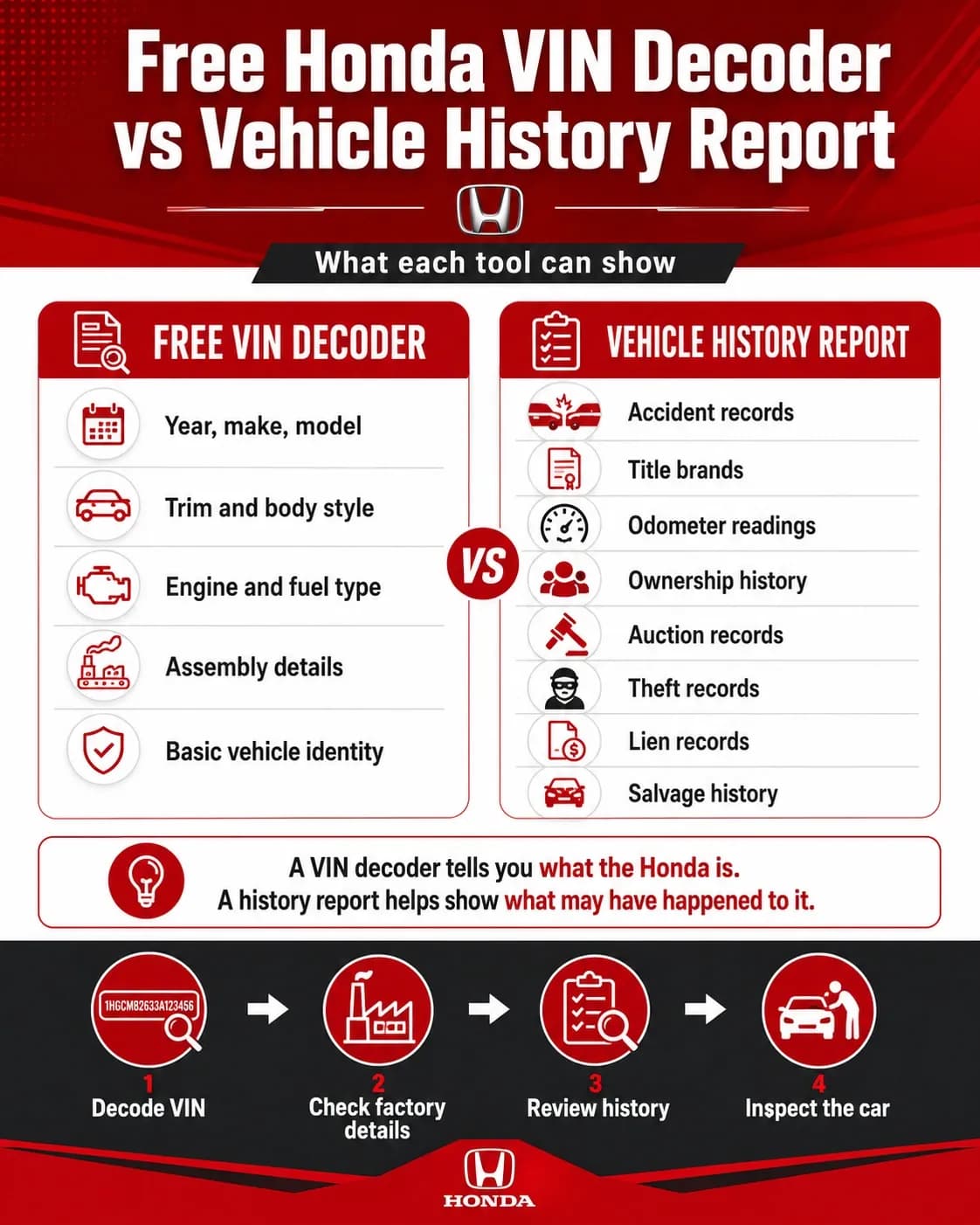
▶ Use a Free VIN Decoder When You’re Browsing
If you are browsing used Honda listings, start with the decoder.
Use it to check the basics: year, model, trim, body style, engine, fuel type, and overall identity. It helps you sort through listings without spending too much time on cars that may not be right.
This is the quick-check stage. Phone in hand, listing open, still deciding whether the car is even worth a call.
▶ Use a History Report When the Honda Gets Serious
Once you’re ready to call the seller, visit the car, negotiate, or leave a deposit, check the history.
This is where a Honda VIN report makes more sense. You are no longer just curious. You are checking risk.
▶ Use Both When Buying or Flipping
For car flippers, both tools matter.
The decoder helps you confirm what you’re buying. The history report helps you understand what you may need to explain later. Buyers will ask about accidents, title status, mileage, and ownership. Better to know before they do.
Why Buyers Should Not Stop at Basic VIN Specs
A clean VIN decode can feel reassuring. The year matches. The trim looks right. The engine checks out.
Nice.
The Honda may decode correctly and still have a branded title, accident record, odometer issue, lien, or auction record. That is the part buyers sometimes miss: a valid VIN does not always mean a clean history.
A decoder proves identity. It does not prove condition.
That’s why a cheap-looking Honda can get expensive later. A missed title brand, a hidden mileage issue, or a bad repair can eat the “deal” fast.
Why Sellers Can Benefit Too
Sellers often think history reports are only for buyers. Not true.
A clean report can make a listing feel stronger. Even when the report has minor records, being upfront can build trust. Buyers dislike surprises more than they dislike small flaws.
✓ It Helps Answer Buyer Questions
If a buyer asks about accidents, title status, or ownership, you can answer with more confidence.
✓ It Supports a Cleaner Listing
A listing with clear specs, original equipment, and history details usually feels more serious than one that only says “runs good.”
✓ It Saves Time
Not every buyer will be the right buyer. Sharing the right information early can reduce wasted messages and awkward negotiations.
A Simple Check Flow Before Buying a Used Honda
Here’s a practical order that works for most buyers.
1. Decode the VIN
Start with the free decoder. Confirm the Honda’s basic identity and make sure the listing is not obviously wrong.
2. Check Factory Details
If the Honda looks promising, review factory details such as window sticker, build sheet, options, colors, and original equipment when available.
3. Review Vehicle History
Before buying, check accident records, title brands, odometer readings, ownership history, theft records, lien records, auction activity, and salvage records.
4. Inspect the Car in Person
A report can guide you, but it cannot inspect paint texture, tire wear, rust, leaks, smells, or repair quality.
Bring a mechanic if the deal matters. A good inspection can catch things a database never saw.
Final Word: Decode First, Then Check the History
A free Honda VIN decoder is useful because it helps confirm what the Honda is. But a Honda vehicle history report helps show what may have happened after it left the showroom.
That difference matters.
Use the decoder early. Use the history report before you buy, sell, or flip the vehicle. The goal is not to scare yourself out of every used Honda. The goal is to stop guessing.
When you are ready to check deeper records, review the Honda vehicle history report and compare it with the seller’s story, the paperwork, and the car in front of you.