
Honda Window Sticker vs VIN Decoder vs Vehicle History Report: Which One Do You Actually Need?
Search Window Sticker
Table of Contents
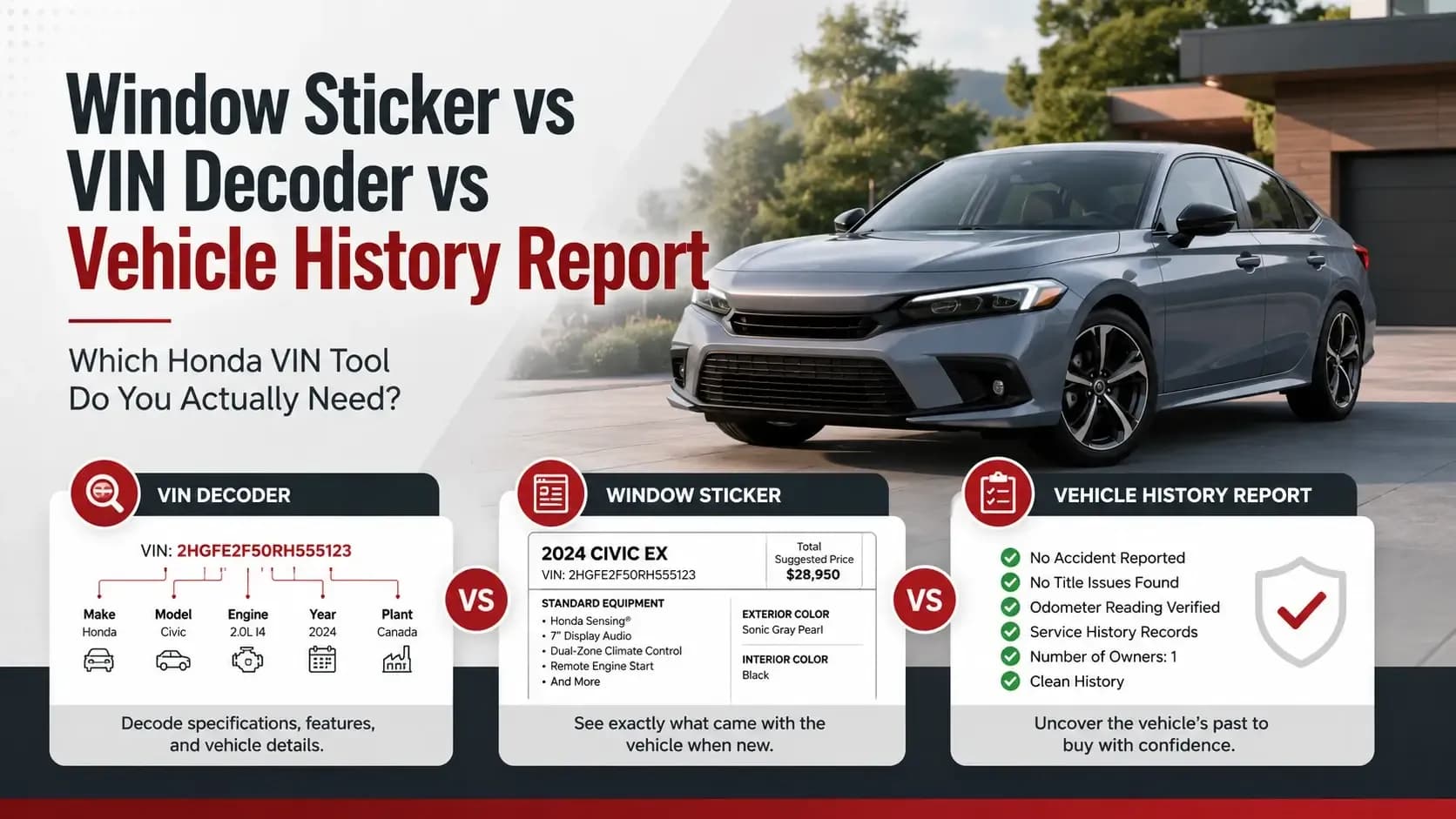
If you’re checking a used Honda, three tools tend to show up fast: a Honda window sticker, a VIN decoder, and a vehicle history report. They sound similar, but they answer very different questions.
A VIN decoder tells you what the vehicle is. A window sticker tells you how it was originally built and priced. A history report tells you what may have happened to it after it left the factory.
That’s the simple version. But if you’re standing in a driveway looking at a used Civic, Accord, CR-V, Pilot, or Ridgeline, “simple” can suddenly feel a little blurry. So let’s sort it out in plain English.
You can start with a free Honda VIN decoder if you only need basic vehicle details.
Key Takeaways
 Use a VIN decoder for free basic specs like year, model, trim, engine, fuel type, and plant.
- Use a Honda window sticker for original factory details like MSRP, equipment, colors, warranty, and fuel economy.
- Use a vehicle history report for deeper used-car records like accident, title, odometer, theft, lien, and ownership history.
First, What Does a VIN Decoder Do?
A Honda VIN decoder reads the vehicle identification number and turns it into basic vehicle information. Think of it as checking the label on a box before opening it.
It usually helps confirm details like:
- Year
- Make
- Model
- Trim
- Body type
- Engine
- Fuel type
- Assembly plant
- Serial number
- Estimated market value
That’s useful because sellers sometimes make mistakes. A listing may say “Touring,” but the VIN may point to a different trim. Or the ad may mention the wrong engine or model year. It happens more often than people admit.
When a VIN Decoder Is Enough
A VIN decoder is enough when you only need basic identification. Maybe you’re comparing two Honda listings online. Maybe you’re checking a title. Maybe you just want to know if the VIN belongs to a 2020 Ridgeline or a 2021 Ridgeline.
It’s quick. It’s free. It gives you a starting point.
When a VIN Decoder Is Not Enough
Here’s the thing: a decoder does not tell the whole story. It will not show accident records, branded titles, lien records, or detailed ownership changes. It also may not show every factory-installed feature.
So, yes, it’s useful. But it’s not a full background check.
So, What Is a Honda Window Sticker?
A Honda window sticker is the factory label that shows how the vehicle was originally equipped when new. You may hear people call it a Monroney label, especially in the U.S. car market.
This is where the details get more interesting.
A window sticker can show:
- Original MSRP
- Standard equipment
- Factory-installed equipment
- Exterior color
- Interior color
- Fuel economy
- Warranty information
- Safety features
- Destination charge
- Engine and transmission details
- Trim and package details
For buyers, this is huge. It helps answer the question, “What was this Honda supposed to have from the factory?”
Why the Window Sticker Matters
Let’s say you’re looking at a used Honda Pilot. The seller says it has premium features, but you want proof. A window sticker can help confirm what came with that vehicle when it was new.
It also helps with pricing. Original MSRP gives you context. It doesn’t tell you today’s exact value, but it helps you understand the starting point.
For car flippers, this matters even more. A clean listing with original factory details can feel more credible. Buyers like proof. Honestly, most of us do.
Where the Window Sticker Fits in the Buying Process
Use the window sticker after you decode the VIN but before you make a serious decision. It gives you factory context before you move into deeper used-car risk checks.
In other words:
VIN decoder first.Window sticker second.History report third, if you’re still interested.
That order keeps things tidy.
Then What Does a Vehicle History Report Show?
A vehicle history report looks at records connected to the car after it was sold or registered. This is the “what happened later?” tool.
A paid Honda history report may show:
Title Brand
This can show records such as salvage, rebuilt, flood, or other title branding that may affect value and resale.
Accident Record
This may reveal reported accident events, damage records, or repair-related history.
Odometer Readings
This helps you compare mileage entries over time and watch for possible mileage inconsistencies.
Ownership History
This can show how the Honda may have changed hands across different owners.
Auction or Sales Records
This may show past sale activity, auction listings, sale dates, or condition notes.
Theft Records
This can help identify whether the vehicle appears in theft or stolen vehicle records.
Lien or Loan Records
This may reveal finance-related records that could affect a purchase decision.
Salvage Records
This can show whether the vehicle has been tied to major damage, insurance loss, or rebuilding.
That’s why a history report is not the same as a window sticker. A sticker is about the original build. A history report is about the vehicle’s life afterward.
The Main Difference in One Simple Comparison
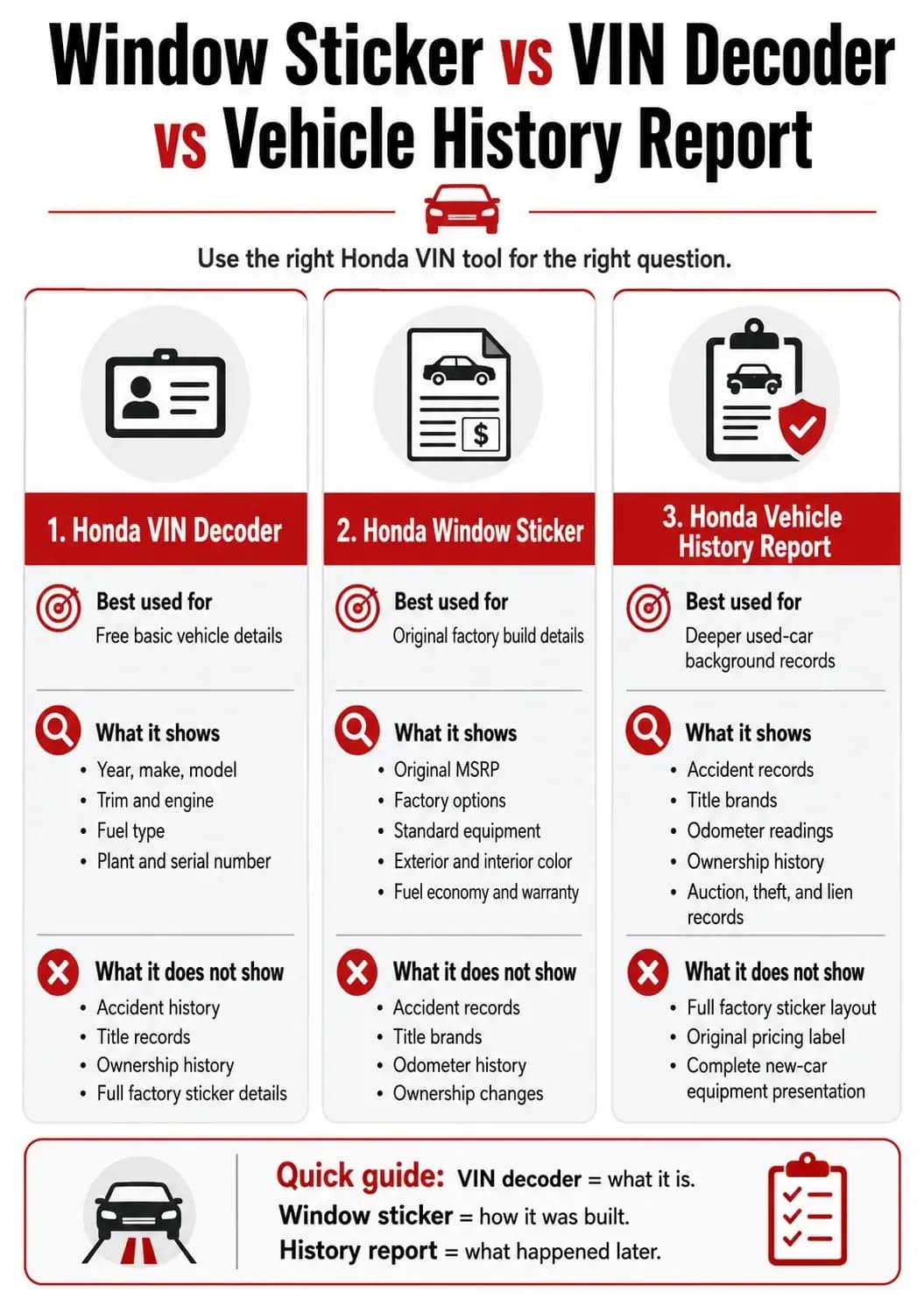
| Tool | Best Used For | What It Shows | What It Does Not Show |
|---|---|---|---|
Honda VIN Decoder | Checking free basic vehicle details | Year, make, model, trim, engine, fuel type, body type, assembly plant, and serial number | Accident history, title records, ownership history, lien records, and full factory sticker details |
Honda Window Sticker | Verifying original factory build details | Original MSRP, factory options, standard equipment, exterior color, interior color, fuel economy, warranty details, and destination charge | Accident records, title brands, odometer history, theft records, and ownership changes |
Honda Vehicle History Report | Checking deeper used-car background records | Accident records, title brands, odometer readings, ownership history, auction records, theft records, lien records, and salvage history | Original window sticker layout, full factory pricing label, and complete new-car equipment presentation |
Here’s a clean way to think about it.
A VIN decoder answers: “What is this Honda?”
A Honda window sticker answers: “How was this Honda originally built and priced?”
A vehicle history report answers: “What has happened to this Honda since then?”
See the difference? Same VIN, three different jobs.
Which Tool Should You Use First?
It depends on where you are in the decision process.
1. If You Are Just Browsing Listings
Start with the VIN decoder. You probably don’t need to pay for deeper records yet. Use the free decode to confirm the model, year, trim, fuel type, and basic specs.
This is helpful when you’re scanning ten listings at lunch and trying not to waste time.
2. If You Like the Vehicle and Want Factory Details
Move to the window sticker. This helps confirm original equipment, colors, MSRP, and factory details.
This is where many buyers catch listing mistakes. A vehicle may look loaded, but the sticker tells you what came from Honda and what may have been added later.
3. If You Are Close to Buying
Check the vehicle history report. This is where you look for accident records, title brands, odometer readings, theft records, lien records, and ownership history.
No report can promise a perfect car. But a history report can help you ask better questions before handing over money.
How These Tools Work Together
Here’s the mild contradiction: you don’t always need all three tools.
But when you’re serious about buying, the three tools work better together.
A VIN decoder gives you the basic identity. A window sticker gives you the original factory picture. A history report adds the real-world background.
It’s a bit like meeting someone new. Their ID tells you who they are. Their résumé tells you what they started with. Their references tell you how things went over time.
Cars are not people, of course. But used cars do have stories. Some are clean and boring, which is great. Some are complicated. The goal is to know which one you’re looking at.
Quick Example: Used Honda Ridgeline
Imagine you’re checking a used 2020 Honda Ridgeline.
The VIN decoder may confirm the model year, engine, body type, fuel type, and drive details.
The window sticker may confirm original color, interior trim, MSRP, standard equipment, factory wheels, tires, and warranty information.
The history report may show whether there are reported accident records, branded title records, odometer entries, lien records, theft records, or auction activity.
Same truck. Same VIN. Different layers of truth.
And if you’re a buyer, those layers matter.
Common Mistake: Expecting One Tool to Do Everything
This is where people get tripped up.
A free VIN decoder should not be expected to show accident history. A vehicle history report should not be expected to show the original MSRP in the same way a window sticker does. A window sticker should not be treated like proof that the vehicle was never damaged.
Each tool has a lane.
When you keep each tool in its lane, the information becomes easier to trust.
Which One Is Best for Sellers?
For sellers, the window sticker is often the strongest presentation tool. It helps show factory equipment, original MSRP, color, trim, and features.
A history report can also help, especially if the records are clean or easy to explain. But the window sticker makes the listing feel more complete.
If you’re flipping cars, documentation matters. Photos get attention, but records build confidence.
Which One Is Best for Buyers?
For buyers, the answer is usually all about timing.
Use the VIN decoder early. Use the window sticker when a listing looks promising. Use the history report before negotiation or purchase.
That flow saves money and time. More importantly, it helps you avoid guessing.
And guessing is expensive in the used-car market.
Final Word: Use the Right Honda VIN Tool for the Right Question
A window sticker vs VIN decoder vs vehicle history report comparison is not about picking one winner. It’s about knowing which tool answers your question.
Need basic specs? Use the VIN decoder.Need original factory details? Use the window sticker.Need deeper used-car records? Use the history report.
If you are close to buying, selling, or verifying a Honda, check the Honda vehicle history report after reviewing the basic VIN details and factory information.